8 Best O Scale Freight Cars for Layouts in 2026
Looking for o scale freight cars for your layout? Compare 8 picks by use, key features and pros and cons to find the right boxcar, hopper or flat car.
 By railroadingonline editorial team
Updated November 7, 2026
As an Amazon Associate I earn from qualifying purchases. This page may contain affiliate links.
Shopping for o scale freight cars can feel like a lot to sort through. O gauge runs on a 1:48 scale with three-rail track, so the cars are big, heavy and full of detail, and the choices range from simple boxcars to highly detailed tank cars and vista-dome pieces. This guide narrows the field to eight models that cover the most common layout needs. Our selection criteria were based on published specifications, brand reputation for accuracy and running quality, and patterns that owners commonly report, such as coupler reliability, wheel quality and how well a car fits a typical consist. We did not run these cars ourselves, so treat the notes below as a research-based overview rather than hands-on testing.
Our Top Picks
Quick Comparison
| Product | Best for | Key feature |
|---|---|---|
| Lionel 684725 Santa Fe Add-On Vista Dome Car | Passenger-style consists and display | Vista dome profile |
| Lionel Norfolk Southern Graffiti HiCube Boxcar | Modern freight trains | High-cube body with graffiti decoration |
| Lionel Union Pacific Standard O Double Door Boxcar 38508 | Classic steam-era and mid-century roster | Double-door boxcar profile |
| Walthers Trainline Chessie Flat Car | Mixed freight and flatcar loads | Traditional flat car body |
| Walthers Trainline 50′ Plug-Door Boxcar Union Pacific | Western railroad themes | Plug-door boxcar with railroad livery |
| Walthers Trainline Insulated Boxcar CSX | Eastern and modern roster | Insulated boxcar body |
| Walthers Trainline Offset Hopper CSX Transportation | Bulk commodity service | Offset hopper body |
| Evemodel 52′ Flat Car Flatbed Transporter (2-pack) | Budget-minded fleet building | Two cars per package |
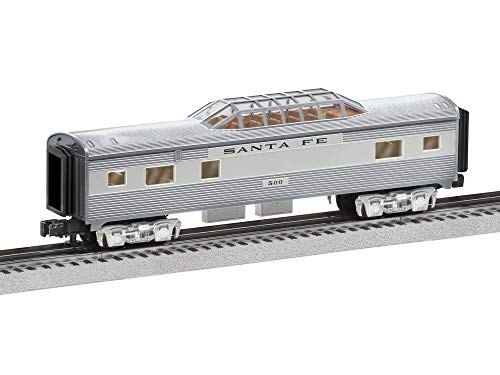
Lionel 684725 Santa Fe Add-On Vista Dome Car
Lionel 684725 Santa Fe Add-On Vista Dome Car, O Gauge, Silver, Gray, Tan, black
This car suits builders who run passenger consists alongside freight or who want a showpiece on the layout. It is an add-on unit, meaning it is designed to extend a Santa Fe train set rather than stand alone as a freight car.
Key specs
- O gauge (1:48 scale)
- Vista dome passenger car body
- Silver, gray and tan finish with Santa Fe lettering
Pros
- Distinctive silhouette that stands out in a consist
- Pairs naturally with Santa Fe passenger equipment
- Good visual anchor for a display shelf
Cons
- Not a freight car, so it limits use for cargo-focused operations
- Works best when matched to a compatible train set
Lionel Norfolk Southern Graffiti HiCube O Gauge Model Train Boxcar

Lionel Norfolk Southern Graffiti HiCube O Gauge Model Train Boxcar | Lionel Norfolk Southern Graffiti HiCube O Gauge Model Train Boxcar
Modern freight operators who want a current-era look will find this car a natural fit. The high-cube body reflects the taller boxcars common on today’s mainlines, and the graffiti decoration adds a lived-in appearance.
Key specs
- O gauge (1:48 scale)
- High-cube boxcar body
- Norfolk Southern livery with graffiti decoration
Pros
- Represents a modern, widely seen car type
- Graffiti finish adds weathering without extra work
- Fits well into a contemporary Norfolk Southern roster
Cons
- Strong decoration may not suit a clean, prototypical look
- Limited appeal for steam-era or pre-1970s layouts
Lionel Union Pacific Standard O Double Door Boxcar 38508

Lionel Union Pacific Standard O Double Door BOXCAR 38508 O Gauge 2443021
Builders modeling classic western railroads, particularly the mid-century period, will get the most out of this boxcar. The double-door design is a recognizable feature that helps set the era.
Key specs
- O gauge (1:48 scale)
- Standard double-door boxcar body
- Union Pacific livery
Pros
- Double-door profile suits classic railroad themes
- Union Pacific roster is popular and easy to match
- Straightforward car that fits many consists
Cons
- Standard boxcar body offers less variety than high-cube models
- Owners who want fine-scale detail may add their own weathering
Walthers Trainline Chessie Flat Car

Walthers Trainline Chessie Flat Car
This flat car works well for builders who want to add variety to a train without buying a full set of boxcars. It is a useful choice for loads such as lumber, machinery or containers.
Key specs
- Flat car body in Chessie livery
- Designed for the Walthers Trainline line
Pros
- Adds variety to a mixed freight train
- Simple design that is easy to load and weather
- Chessie livery adds a distinctive color scheme
Cons
- Flat cars carry no built-in detail, so loads must come from elsewhere
- Limited relevance for layouts modeling a different railroad era
Walthers Trainline 50′ Plug-Door Boxcar Union Pacific

Walthers Trainline 50' Plug-Door Boxcar-Ready to Run-Union Pacific(R) 931-1672 HO Scale Model Railroad – Freight Model
Western layout builders who want a 50-foot plug-door boxcar in Union Pacific colors will find this car a practical choice. Plug-door boxcars were common for shipping goods that needed protection from the weather.
Key specs
- 50-foot boxcar body
- Plug-door design
- Union Pacific livery
Pros
- Plug-door body is a recognizable prototype feature
- Pairs well with other Union Pacific equipment
- Good length for a realistic consist
Cons
- Older design may look plain beside newer high-cube cars
- Some owners report that couplers need adjustment on sharp curves
Walthers Trainline Insulated Boxcar CSX

Walthers Trainline Insulated Boxcar-Ready to Run-CSX 931-1804 HO Scale Model Railroad – Freight Model
Eastern and modern-era modelers who need an insulated boxcar for refrigerated or temperature-sensitive loads will find this a sensible addition to the fleet.
Key specs
- Insulated boxcar body
- CSX livery
Pros
- Insulated body is a recognizable car type
- CSX livery suits eastern and modern settings
- Useful for adding variety to a boxcar fleet
Cons
- Limited appeal for steam-era or western-themed layouts
- Owners often add their own weathering to match the rest of the fleet
Walthers Trainline Offset Hopper CSX Transportation

Walthers Trainline Offset Hopper-Ready to Run-CSX Transportation (Blue, Yellow; Boxcar Logo) 931-1425 HO Scale Model Railroad – Freight Model
Builders who want bulk commodity cars for coal, grain or aggregate loads will appreciate the offset hopper profile. Hoppers are among the most common cars in a working freight train.
Key specs
- Offset hopper body
- CSX Transportation livery with boxcar logo
Pros
- Hoppers add realistic bulk-freight traffic
- Offset profile is a recognizable prototype
- CSX livery suits eastern-themed layouts
Cons
- Hoppers look best when loaded, so a separate load is usually needed
- Limited relevance for western or steam-era layouts
Evemodel 52′ Flat Car Flatbed Transporter (2-Pack)

Evemodel C8741U 2pcs HO Scale 1:87 52' Flat Car Flatbed Transporter U.S.Army 52ft Model Train Container Carriage Freight Car
This two-car package suits builders who want to expand a fleet quickly, or who model military and transport trains. The 52-foot flat car body reflects the flatbed transporters used for heavy and oversized equipment.
Key specs
- 52-foot flat car body
- Sold as a two-piece set
- U.S. Army transporter theme
Pros
- Two cars in one package help build a fleet
- Long flatbed suits heavy-equipment loads
- Good fit for military or transport themes
Cons
- Detail and finish may differ from premium brands
- Owners sometimes report that couplers and trucks need tuning for smooth operation
Buying Guide
Selection Criteria
When comparing o scale freight cars, start with the era and railroad you want to model. A car that looks right on a 1950s western mainline may look out of place on a modern eastern layout. Next, look at the car type: boxcars, hoppers, flat cars and specialty cars each serve different traffic roles, and a balanced train usually mixes several types. Finally, consider running quality, since couplers, wheels and trucks determine whether a car works reliably on your track.
Important Features
- Car type: Match boxcars, hoppers, flats and tank cars to the traffic you want to represent.
- Livery and era: Railroad markings and lettering should match the year you are modeling.
- Coupler type: Check whether the car uses the coupler system your other equipment already uses.
- Detail level: Some cars come with separate details like grab irons and ladders, while others need added parts.
- Body profile: Standard, high-cube and insulated bodies look different in a consist.
Specs to Check
- Scale and gauge (O gauge, 1:48 scale, three-rail track)
- Car length and body style as listed by the manufacturer
- Included decoration and lettering
- Whether the car is ready to run or needs assembly
- Coupler and truck type
Choosing by Need
If you want a showpiece for a display shelf, a distinctive car such as the vista dome model fits well. For a working freight train, a mix of boxcars and hoppers provides the most realistic traffic. If your layout is modeling a specific era, prioritize cars whose livery and body style match that period. Budget-minded builders can use two-car packages to fill out a fleet faster while saving on individual purchases.
Things to Watch Out For
- Mixing cars with different coupler heights can cause derailments or uneven train profiles.
- Heavy O scale cars may stress older track or weak power, so check your locomotive’s pulling capacity.
- Some owners report that out-of-the-box weathering is too uniform, so plan to add your own touches.
- Check that a car is intended for your track system, since O gauge comes in both two-rail and three-rail versions.
If you are just getting started, our guide to H O Scale Freight Cars: A Step-by-Step Guide to Choosing and Building Your Fleet covers fleet-building principles that apply across scales. Builders focused specifically on O gauge may also find 6 Best O Scale 2-Rail Freight Cars for Layouts in 2026 useful for comparing track-system options. For collectors, Why Are O Gauge Freight Cars Worth Collecting? 6 Reasons and Tips explains why many buyers focus on O gauge models.
FAQ
What is the difference between O scale and O gauge?
O gauge refers to the track gauge, which is about 1.25 inches between rails on three-rail track. O scale is 1:48 in proportion to the prototype. Many manufacturers use both terms, and O gauge cars are generally built to O scale proportions.
Can I run O scale freight cars on two-rail track?
Some O scale cars are sold for two-rail operation and others for three-rail. Check the product listing and packaging before buying, and confirm that your track and power system support the rail type you plan to use.
Which car type should I buy first?
A boxcar is a versatile starting point because it fits most eras and railroads. Once you have boxcars, adding a hopper and a flat car gives your train more variety.
Do O scale freight cars need weathering?
Many builders weather their cars to make them look more realistic, since factory finishes are often clean. Light weathering with washes, dry brushing and dust effects is a common approach, though the amount is a matter of personal taste.
How do I keep O scale cars running smoothly?
Owners commonly report that clean wheels, properly adjusted couplers and level track make the biggest difference. Check couplers regularly, especially on curves, and match coupler heights across the train.
Are O scale cars compatible with HO scale cars?
No. O scale is significantly larger than HO scale, so the two are not interchangeable. Mixing scales on one layout requires separate track and power systems.
Should I consult a professional for repairs?
For mechanical or electrical repairs, especially on powered units or vintage pieces, consider consulting a qualified model train repair technician. Simple adjustments like coupler alignment and wheel cleaning are usually manageable at home.
Conclusion
The right o scale freight cars depend on what you want to model. For a display or passenger-style look, the Lionel Santa Fe vista dome car stands out. For modern freight, the Norfolk Southern high-cube boxcar fits well. Classic western layouts pair naturally with the Union Pacific double-door boxcar and the 50-foot plug-door boxcar from Walthers. Eastern and modern roster builders may prefer the CSX insulated boxcar or offset hopper. Flat car and transporter options round out a mixed train, and the Evemodel two-pack helps fill out a fleet. Matching car type, era and livery to your layout will give you the most satisfying result.
Related reading
- Kato N Scale Freight Cars: Which Models to Buy and Why
- 10 Best HO Scale Freight Cars for Sale in 2026: Buyer's Guide
About the author

railroadingonline editorial team writes reviews and buying guides for Railroading Online.