7 Best N Scale Train Freight Cars of 2026
Looking for the best N scale train freight cars? Compare seven well-regarded models by detail, couplers, and fit for your layout before you buy.
 By railroadingonline editorial team
Updated November 7, 2026

As an Amazon Associate I earn from qualifying purchases. This page may contain affiliate links.
Choosing N scale train freight cars can feel overwhelming, especially when every box car, hopper, and stock car looks promising in a catalog photo. The right fleet depends on more than appearance. You need cars that roll smoothly on your track, couple reliably, carry plausible reporting marks for your era, and match the prototype railroads you want to model. This guide compares seven freight car options that owners and hobby retailers commonly point to, grouped by what they do well. We judged them on published specifications, manufacturer reputation, coupler and wheel design, and the kinds of feedback model railroaders tend to share about detail, running quality, and consistency across the lineup.
Our Top Picks
Quick Comparison
| Product | Best for | Key feature |
|---|---|---|
| KATO 10-033 N Gauge Freight Train, Set of 6 | Starting a varied freight train quickly | Six cars in one set with mixed car types |
| Bachmann Trains AAR 40′ Steel Box Car Christmas NP&S Present Express | Seasonal and holiday-themed displays | Highly detailed body with precision graphics |
| Bachmann Trains Stock CAR Pennsylvania #128781 | Pennsylvania Railroad era layouts | Prototype livery for a classic eastern road |
| Bachmann Trains ACF 50’6″ Sliding Door Box Car Detroit & Mackinac | Detail-focused boxcar fleets | Outside-braced body with E-Z Mate couplers |
| Walthers Trainline Offset Hopper CSX Transportation | Modelers working in HO-style comparisons or mixed-scale displays | Ready-to-run hopper with CSX graphics |
| KATO 8025 N Gauge Wala 1 (2 Cars) | Two-car add-on purchases | Compact two-pack for expanding a fleet |
| KATO 8084 N Gauge REM 5000 (2-Car) | Long-consist operators and Japanese-prototype fans | Two-car set with Kato’s established N scale running gear |
KATO 10-033 N Gauge Freight Train, Set of 6
KATO 10-033 N Gauge Freight Train, Set of 6, Model Railway Freight Cars
This set suits newer modelers who want a varied train on the rails right away rather than assembling a fleet car by car. It also works well for a first mainline consist that can be expanded later with single-car purchases.
Key specs
- Set of six N scale freight cars
- Mixed freight car types in one package
- KATO N gauge (1:160) model railroad rolling stock
Pros
- Delivers a complete, varied consist in a single purchase
- Consistent styling across the set makes a cohesive train
- Good starting point for building an operating freight train
Cons
- Limited to the car types included, so specialty cars require separate buys
- Commitment to six cars at once may be more than a small layout needs
Bachmann Trains AAR 40′ Steel Box Car Christmas NP&S Present Express

Bachmann Trains AAR 40' Steel Box Car Christmas NP&S Present Expres N Scale | Rolling Stock, Steel Box Car, Highly Detailed Body with Precision Graphics, Metal Wheels and E-Z Mate Couplers, 17071
This car fits modelers who want seasonal flavor on a layout or who enjoy holiday-themed scenes during the winter months. It also appeals to collectors who prefer distinctive paint schemes over standard railroad liveries.
Key specs
- AAR 40-foot steel box car prototype
- N scale (1:160)
- Metal wheels and E-Z Mate couplers
Pros
- Highly detailed body with precision graphics
- Metal wheels help with reliable electrical pickup and rolling
- E-Z Mate couplers simplify uncoupling and consist building
Cons
- Holiday livery is a specialty choice rather than a general-purpose car
- Limited appeal for layouts set in strictly prototypical industrial eras
Bachmann Trains Stock CAR Pennsylvania #128781

Bachmann Trains – Stock CAR Pennsylvania #128781 – N Scale
This stock car suits modelers building Pennsylvania Railroad scenes, particularly those who want livestock traffic in the consist. It is a good fit for historically minded layouts where a period-correct roster matters.
Key specs
- Stock car prototype in Pennsylvania Railroad livery
- N scale (1:160)
- Road number 128781
Pros
- Adds a less common car type to a freight roster
- Pennsylvania livery supports a classic eastern railroad theme
- Bachmann N scale rolling stock is widely available for matching fleets
Cons
- Single-car purchase, so building a full train takes several orders
- Stock cars are a niche service, so frequency on the layout should be planned
Bachmann Trains ACF 50’6″ Sliding Door Box Car Detroit & Mackinac

Bachmann Trains ACF50'6" Sliding Door Box Car Detroit & Mackinac N Scale | Rolling Stock, Outside Braced Box Car, Highly Detailed Body-Precision Graphics, Metal Wheels and E-Z Mate Couplers, 19671
This boxcar is aimed at modelers who prioritize body detail and want a sliding-door car that reads well in close-up photography. It works for mid-century and later layouts where the ACF design was common.
Key specs
- ACF 50-foot sliding door box car prototype
- Outside-braced body design
- Metal wheels and E-Z Mate couplers
Pros
- Outside-braced body adds visible prototype detail
- Precision graphics suit a detail-focused fleet
- E-Z Mate couplers keep operation simple
Cons
- Sliding-door details can be fragile during handling, so careful storage is advised
- Single car, so building a varied train requires additional purchases
Walthers Trainline Offset Hopper CSX Transportation

Walthers Trainline Offset Hopper-Ready to Run-CSX Transportation (Blue, Yellow; Boxcar Logo) 931-1425 HO Scale Model Railroad – Freight Model
This hopper is for modelers who want a ready-to-run CSX car for a bulk-commodity train. Because the listing is tagged as HO scale, check the scale before buying if you model strictly in N.
Key specs
- Offset hopper prototype in CSX Transportation livery
- Ready-to-run configuration
- Listed as HO scale on the product name
Pros
- Ready-to-run design requires no assembly
- CSX livery is recognizable and suits modern-era layouts
- Offset hopper adds variety to a freight roster
Cons
- Scale mismatch risk for N scale layouts; verify before purchase
- Single car, so a full consist needs multiple orders
KATO 8025 N Gauge Wala 1 (2 Cars)

KATO 8025 N Gauge Wala 1 (2 Cars) Railway Model Freight Car
This two-car pack suits modelers adding to an existing KATO fleet or building a small consist without committing to a large set. It is also a reasonable choice for experimenting with Japanese-prototype freight in N scale.
Key specs
- Two-car pack in N gauge
- KATO N gauge (1:160) rolling stock
- Freight car model
Pros
- Two-car pack offers a moderate, manageable purchase
- KATO N scale running gear is well regarded for smooth operation
- Easy to match with other KATO freight cars
Cons
- Limited road and livery variety compared with larger sets
- Prototype may not suit every North American-focused layout
KATO 8084 N Gauge REM 5000 (2-Car)
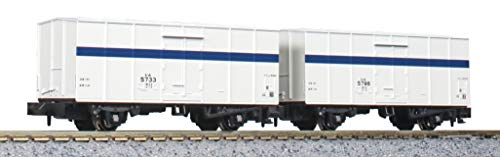
KATO 8084 N Gauge REM 5000 (2-Car) Railway Model Freight Car
This two-car set appeals to modelers who want a consistent KATO look across a fleet and who enjoy expanding a consist one pair at a time. It also suits those drawn to distinctive, less common freight car designs.
Key specs
- Two-car set in N gauge
- KATO N gauge (1:160) freight car model
- REM 5000 designation as listed
Pros
- Two cars provide a manageable addition to a roster
- KATO quality standards help cars run together reliably
- Distinctive design adds character to a train
Cons
- Specialized design may be harder to match with North American rosters
- Only two cars, so a full consist requires further purchases
Buying Guide
Before you add cars to a cart, decide what kind of railroad you are modeling. Era, region, and traffic type should drive your choices more than any single product feature.
Selection criteria
- Scale and gauge. N scale is typically 1:160 on 9 mm track. Confirm the scale on the listing, especially for hoppers and boxcars that may be offered across several scales.
- Couplers. Check whether the car uses NMRA-compatible couplers or a proprietary design, and whether it matches the rest of your fleet.
- Wheelsets. Metal wheels generally provide better electrical pickup and a more consistent roll than plastic wheels on many layouts.
- Prototype and era. A car in the right livery and body style for your chosen decade adds believability.
Important features to look for
- Detail level. Separate grab irons, applied brake gear, and crisp printing are common markers of higher-detail models.
- Running quality. Owners frequently report that well-built trucks and properly gauged wheelsets reduce derailments on switches and curves.
- Weight. Adequate weight improves pulling power and stability, particularly for long consists.
Specs to check before buying
- Scale (N, 1:160)
- Coupler type and height
- Wheel material and flange profile
- Reporting marks and road number for your era
Choosing by need
- Starting a layout: a multi-car set gives you a train quickly.
- Expanding a fleet: two-car packs let you add variety without overspending on a single purchase.
- Historical accuracy: pick cars with the correct livery for your railroad and decade.
- Seasonal or themed scenes: specialty liveries can add charm but should be used in moderation.
Things to watch out for
- Scale mismatches: some listings are tagged for other scales. Read the name carefully.
- Coupler incompatibility: mixing coupler systems can cause uncoupling problems.
- Over-weighted or under-weighted cars can cause uneven running in long trains.
For more background, see Kato N Scale Freight Cars: Which Models to Buy and Why and 10 Best Bachmann HO Freight Cars Silver Series for Model Railroaders (2026). If you are also planning control hardware, 6 Best N Scale DCC Controllers for Beginners and Layout Builders (2026) covers the electronics side.
FAQ
What does N scale mean for freight cars?
N scale is a model railroad scale of 1:160, using 9 mm track gauge. Freight cars in N scale are much smaller than HO models, which is why they are popular for layouts with limited space.
Are metal wheels better than plastic wheels?
Metal wheels generally conduct electricity better and can improve pickup on layouts with lighting or sound decoders. Plastic wheels run quietly and are common on budget models. Many modelers prefer metal wheels for their weight and consistency.
Can I mix KATO and Bachmann N scale cars in one train?
Often yes, since both brands produce N scale rolling stock. However, coupler types and wheel standards can differ, so test a few cars on your track before committing to a mixed consist.
How many freight cars should a train have?
There is no fixed rule. Many small layouts run trains of four to eight cars, while larger railroads may operate much longer consists. Match the length to your siding lengths and the tightness of your curves.
Do I need to weigh my freight cars?
Weighting is optional on flat, level track with short trains, but it helps on grades and long consists. Owners often add weight to improve traction and reduce bouncing.
Should beginners buy a set or individual cars?
A set provides a complete train quickly and avoids mismatched styles. Individual cars allow more control over the roster and era. Beginners often start with a set and add single cars over time.
Where can I learn more about building a fleet?
For a broader overview, see H O Scale Freight Cars: A Step-by-Step Guide to Choosing and Building Your Fleet. Reading a few guides before buying can save you from costly scale or coupler mistakes.
Conclusion
For a quick, varied train, the KATO 10-033 six-car set is the most complete starting point among these choices. Modelers focused on detail will find the Bachmann ACF box car and the AAR steel box car rewarding. Those building a historically specific Pennsylvania scene should consider the Pennsylvania stock car. Two-car KATO packs suit anyone expanding an existing roster one step at a time. Whichever you choose, confirm the scale, coupler type, and era before ordering, and test-run new cars on your track. A well-matched fleet of N scale train freight cars will make your layout feel alive far sooner than a collection of mismatched models.
About the author

railroadingonline editorial team writes reviews and buying guides for Railroading Online.